

Point Cloud Based Deformation Analysis - Standard Procedures and Advanced Methods
Workshop Description:
Content Standard Procedures – Point Cloud Comparison:
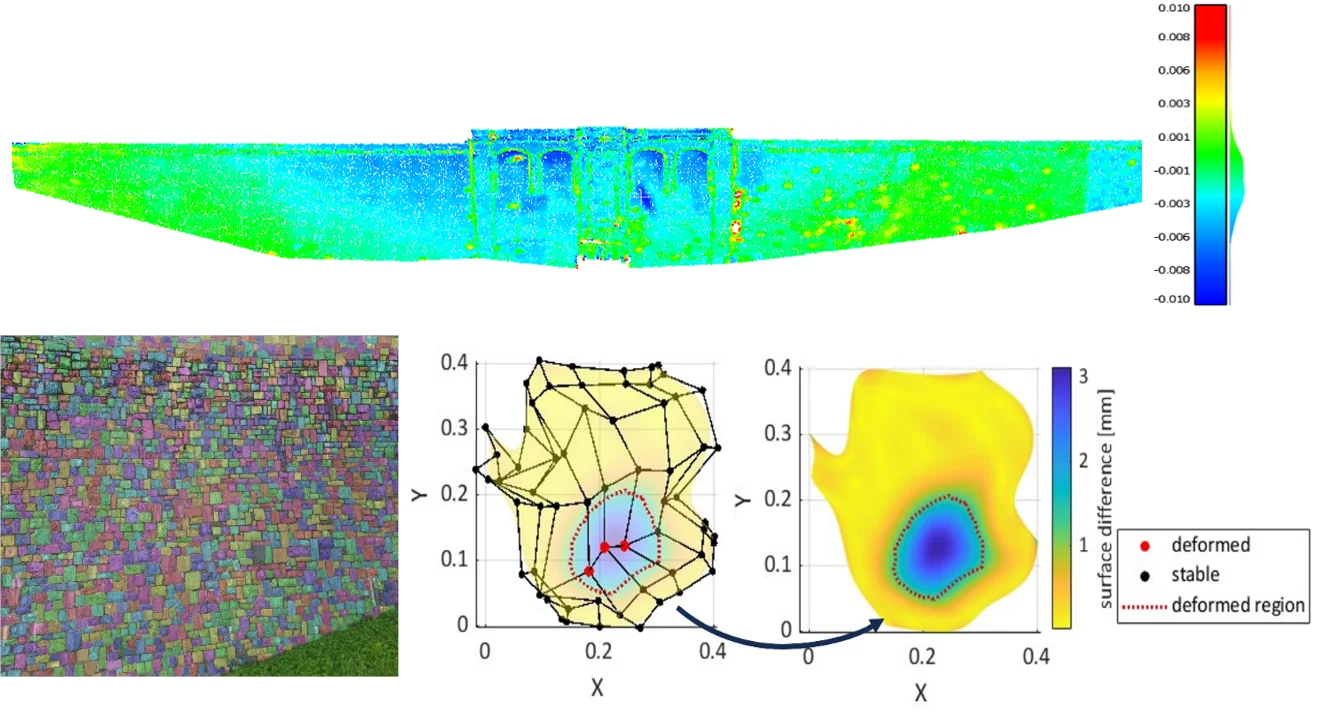
Introduction into deformation analysis, change detection and point cloud comparison; followed by a more detailed introduction into point cloud comparison, separation between 3D movements, in-plane and out-of-plane movements. This part focusses on out-of-plane movements. The description of cloud-to-cloud (C2C), cloud-to-mesh(C2M), mesh-to-mesh (M2M) and multiscale model-to-model cloud comparison (M3C2) will be next.
In the practical part the different techniques will be compared and the parameters of e.g. the M3C2 will be varied too. The results for deformed objects will be compared and analyzed, amongst others, on data of the Brucher dam.
Content Advanced Methods – Feature Based and Surface Based Deformation Analysis
A) This part will begin with an introduction to feature-based deformation determination.In contrast to point cloud comparison, this approach enables the estimation of 3D movements and deformations. The focus will be on the detection of clearly identifiable regions or points that can be matched between two observation epochs. Segmentation is performed using image or LiDAR data. These techniques are developed in an application-oriented manner, here specifically for the stones of the Brucher Dam.In the practical session, the different segmentation results and the resulting 3D movements will be compared in order to highlight the advantages and disadvantages of the different approaches. Additionally, differences with respect to pure point cloud comparison methods will be computed and analyzed.
B) This part will focus on surface-based statistical deformation analysis. After the presentation of the basics of deformation analysis (global congruency test and localization) and a summary about surface representation techniques, the statistical tests based on control points of B-Spline surfaces will be introduced. The consideration of correlations within the point cloud will be addressed too.In the practical part the results for deformed objects are compared, e.g. for different parametrization. The effect of neglection of correlations in the Variance-covariance matrix will be analyzed too. Additionally, the results will be compared (where possible) to the results of the standard procedures.
Final Comparison
Finally, the results of the three methods (where possible) will be compared based on the given data sets.
Organizers:
- Prof. Dr.-Ing. habil. Dr. h.c. Volker Schwieger
- Prof. Dr.-Ing. Heiner Kuhlmann
- Prof. Dr.-Ing. Christoph Holst
- Prof. Dr.-Ing. Corinna Harmening
- Dr.-Ing. Yihui Yang
- M.Sc. Pauline Speidel
- M.Sc. Annika Tobies
- M.Sc. Elisabeth Ötsch
Target Group and Requirements:
Basic knowledge about point clouds /TLS,Participation at Workshop “Freeform surface representation from TLS-Point clouds” recommended.Teaching form and data base:
The workshop will start with a general introduction to the topic. For each of the three topics an introductory lecture will be followed by practical exercises on the computer using commercial and freely available software as well as own written code. The practical training will base on already acquired data of the Brucher Dam near Bonn as well as data of test specimens processed in the Surface representation workshop.